

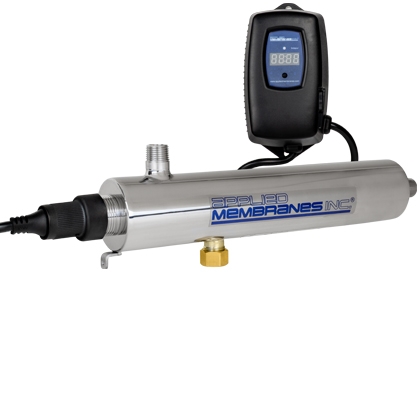

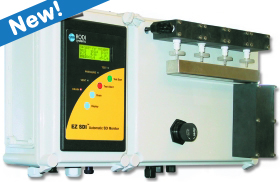
Automatic SDI Monitor - EZ SDI
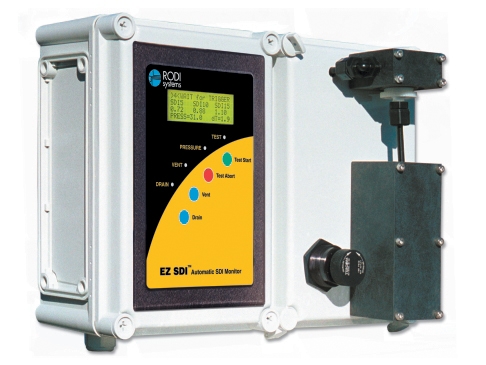
The EZ™ and Enhanced SDI monitors automatically and consistently monitor the silt density index of RO feedwater. Monitoring the SDI is very useful to determine fouling problems before the membranes need replacement.
The EZ SDI™ is microprocessor controlled and fully automatic, allowing operators to quickly and regularly check the effectiveness of the RO pretreatment system.
The EZ SDI™ is designed for permanent installation. In order to prevent stagnant conditions in the sample line, the monitor continuously allows a side stream of sample to flow through the monitor up to the point where the sample enters the filter. A specially designed orifice controls the rate of this side-stream flow. The orientation of the flow control orifice also allows air in the sample line to be separated from the sample before the sample enters the filter holder.
The EZ SDI unit performs one test at a time, while the EZ SDI-4 performs up to 4 tests between filter change-outs
Purchase Now » Request A Quote »Benefits
- Monitor feed water SDI to determine fouling problems before membranes need to be replaced. Prevent fouling and prolong the life of membrane elements to reduce maintenance costs.
- Fully Automatic: SDI measurement can be taken by pushing a button
- Display equipped with LED backlight, so SDI test results can be seen in any environment
- Test pressure is controlled with an internal pressure regulator, which can accommodate inlet pressures above 1000 psi.
- Designed for On-line Operation
- Fast and Easy SDI Filter Replacement
- Easy to Install & Operate
Details
|
Model No. |
Description |
|
EZSDI-1 |
EZ SDI™ Automatic Silt Density Index Monitor, Performs 1 test a time with disposable cartridge filters |
|
EZSDI-4 |
EZ SDI-4™ Automatic Silt Density Index Monitor will perform four separate tests before filter replacement is necessary. |
|
EZSDI-SS-USAU |
Sample sequencer for EZ SDI-4 *For use in USA |
|
EZSDI-SS-INTU |
Sample sequencer for EZ SDI-4 *For use outside of USA |
|
|
|
|
EZSDI-1 |
EZSDI-4 |
Features
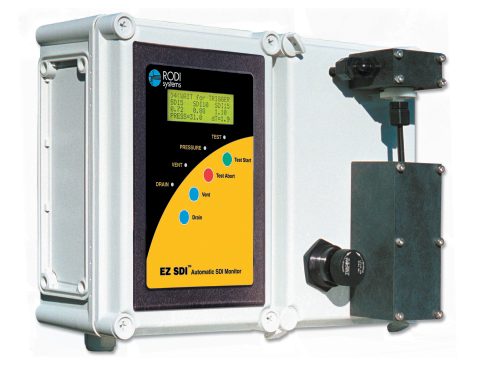
- Automatic – Easy to Install and Operate
- Uses standard filter media
- Replacing the media is an easy 2-minute process
- Monitor housed in NEMA 4X enclosure
- Designed for permanent installation
- Complies with ASTM D4189-95
- The EZSDI-4 will perform four separate tests before filter replacement is necessary.
- Discrete Outputs: One Normally-Open Form A, 2 Amp, 30 VDC/240 VAC
- Analog Outputs: Four 4-20 mA (optional)
- Serial Ports: One RS-232 (RJ Connector) for data download
- User Interface: 4 x 20 LCD with backlight; 4 Keys, Tactile
- Realtime Clock: Backed with Lithium Battery, 10 Year Life
- Power: 120-240 VAC,50-60 Hz, 0.8 A
- Mounting Wall Mounting
- Electrical: All connections via removable screw terminals.
- Environment: 0 to 50°C (32 to 122°F), 10 to 90% relative humidity, non-condensing
Applications
SDI (Silt Density Index) Monitoring for:
- Reverse Osmosis Systems
- UltraFiltration Systems
- MicroFiltration Systems
Parts
Spare Parts for EZ SDI
|
Model No. |
Description |
Qty. in Pkg. |
|
EZSDI-439 |
¼” Fuse 2 Amp, 250v |
1 |
|
EZSDI-257 |
¼” ID Drain Tubing |
5 Feet |
|
EZSDI-133 |
¼” OD Vent Tubing, 250 PSI |
100 Feet |
|
EZSDI-466 |
Silicone O-Ring |
1 |
|
EZSDI-496 |
Disposable Filter Cartridges |
100 |
|
EZSDI-498 |
Cartridge Filter Fitting |
1 |
|
EZSDI-903 |
Manifold Solenoid Valve with Teflon Plunger |
1 |
|
EZSDI-902 |
Drain Solenoid Valve with Teflon Plunger |
1 |
|
EZSDI-536 |
Vent Solenoid Valve with Teflon Plunger (for EZ SDI-4) |
1 |
|
EZSDI-112 |
Water Vent Tubing Flow Orifice |
1 |
|
EZSDI-134 |
Air and Water Vent Tubing Bulkhead connector |
1 |
|
EZSDI-256 |
Drain Tube Hose Barb |
1 |
Spare Part Replacement Kits for EZ SDI
|
Model No. |
Description |
|
EZ-1C-2YSPK |
Two-Year Spare Parts Kit for EZ SDI-1C |
|
EZ-4-2YSPK |
Two-Year Spare Parts Kit for EZ SDI-4 |
Contact us
for a quote or for any additional information
or call us at 1.800.321.9321




