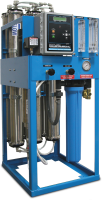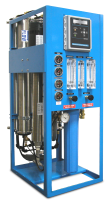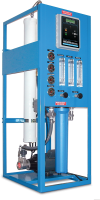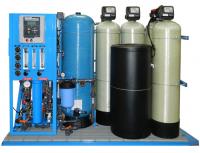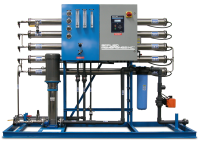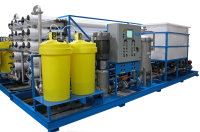
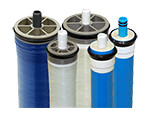

Reverse Osmosis Systems (RO Systems)
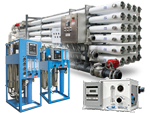
Reverse Osmosis RO Systems

What is Reverse Osmosis (RO)? 

Reverse osmosis (RO) is a membrane separation process in which feed water flows along the membrane surface under pressure. Purified water permeates the membrane and is collected, while the concentrated water, containing dissolved and undissolved material that does not flow through the membrane, is discharged to the drain.

The key requirements of  Reverse Osmosis (RO) process are a membrane and water under a pressure. Other requirements include prefiltration to remove suspended impurities and carbon to remove chlorine (damages the membrane).

Most membranes remove 90-99+ % of the dissolved impurities depending on the impurity and the composition of water. 

Reverse osmosis systems (RO Systems) remove salts, microorganisms and many high molecular weight organics. System capacity depends on the water temperature, total dissolved solids in feed water, operating pressure and the overall recovery of the system.


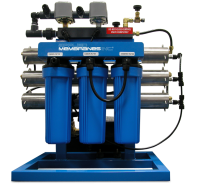
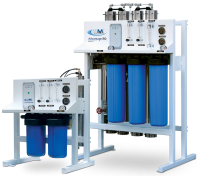
Applied Membranes manufactures Reverse Osmosis Systems (RO Systems) ranging from 24 gallons to millions of gallons per day, treating municipal, well, surface and sea water.  Please choose from your application and flow range below to view our systems in your size.

Note:  we have commercial RO systems in stock ranging from 9 to 175 GPM.  Please Contact Us for details.

Reverse Osmosis Systems for Tap/Brackish Water

Series AA Reverse Osmosis Systems

220-700 Gallons Per Day
For Feed Water TDS 500 to 1000 PPM

Small, Compact Commercial Reverse Osmosis System
Ideal for applications such as restaurants, aquariums, small manufacturing, and a wide variety of other applications.


Series L Reverse Osmosis Systems
300-19,000 Gallons Per Day
For Feed Water TDS 500 to 1000 PPM

Small Commercial Reverse Osmosis System
Ideal for applications such as spot free rinse, water stores, whole house, labs, ice makers, humidification, misting and a wide variety of other applications.

Series XL - Low Energy RO Systems
2,000 - 10,000 Gallons Per Day
For Feed Water TDS less than 500 PPM

Low Energy Reverse Osmosis System
Energy efficient low energy membranes run at 100-140 psi.  Ideal for applications such as spot free rinse, water stores, whole house, labs, ice makers, humidification, misting and a wide variety of other applications.

Series HL High Feed TDS RO Systems
300-9,000 Gallons Per Day
For Feed Water TDS 1000 to 5000 PPM

Reverse Osmosis System for Higher TDS
Ideal for applications such as spot free rinse, water stores, whole house, labs, ice makers, humidification, misting and a wide variety of other applications.

XL System

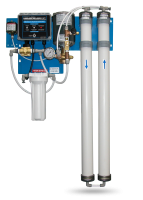
L System

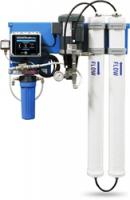
HL System


Series WM - Wall Mount Systems
250 - 4,500 Gallons Per Day
Wall-Mount Reverse Osmosis Systems
Designed to produce low dissolved solids water from tap or well water, these systems use high efficiency reverse osmosis membranes. The product water is used in applications such as spot free rinse, water stores, whole house, labs, ice makers, humidification, misting and a wide variety of other applications.

Series PW - Packaged Water Filtration
1,800-10,000 Gallons Per Day
Complete Mini Water Purification Plant
From pretreatment, reverse osmosis to post treatment and storage tanks, the package is ready to produce high quality water for many applications. These include water stores, water jet cutting machines, pharmaceutical, manufacturing and other industrial uses.
 

Packaged Water System
Home RO Systems for Under The Counter Installation

Home Reverse Osmosis Systems
4 to 6 Stage,  12 - 200 Gallons Per Day
Residential Reverse Osmosis System

For under-the-Sink installation, our AAA series RO systems are commonly used in homes or offices.  Options include Ultraviolet Sterilization, Feed booster pump, or compact 4-stage units. 

Commercial & Industrial RO for Tap/Brackish Water

Series J Commercial RO Systems
11,500 - 28,800 Gallons Per Day
Commercial Reverse Osmosis Systems
The product water is used in applications such as rinse water, pharmaceutical, food processing, bottled water, hotels, beverage, hospitals, and a wide variety of other applications.


Series K Industrial RO Systems
28,000 - 324,000 Gallons Per Day
Industrial Reverse Osmosis Systems
The product water is used in applications such as semiconductor, boiler feed, pharmaceutical, municipal, water reuse, food processing, bottling, and a wide variety of other applications.


Seawater Reverse Osmosis Systems
Watermakers - Series SY
100-1,600 Gallons Per Day
Compact Seawater RO Desalination Systems
Our  Watermaker (Series SY) Reverse Osmosis Seawater Systems convert seawater to drinking water. Their compact design makes them ideal for use on yachts, boats, cruise ships, and resorts.

Series S-  Seawater RO Systems
2,000 - 132,000 Gallons Per Day
Seawater Reverse Osmosis RO Systems

These RO Systems convert seawater to drinking water using seawater desalination membranes. The product water is used in a variety of areas including hotels, resorts, navy, and off-shore platforms.

Series S Seawater System

Custom Seawater Systems for your application
Applied Membranes’ experience extends beyond standard seawater desalination systems. We have supplied complete systems with Energy Recovery, Data Logging, Containerized Systems, Explosion Proof Systems, Portable Systems for Military Operation, and many more up to millions of gallons per day.  AMI welcomes the opportunity to work with you to fulfill your specific filtration needs.

Mobile Water Treatment Systems for Lease or for Sale


RO System in a 40' Container

Reverse Osmosis RO System Removes up to 99% of Total Dissolved Solids

Reverse osmosis is a membrane separation process in which feed water flows along the membrane surface under pressure. Purified water permeates the membrane and is collected, while the concentrated water, containing dissolved and undissolved material that does not flow through the membrane, is discharged to the drain.

Reverse osmosis systems remove salts, microorganisms and many high molecular weight organics. System capacity depends on the water temperature, total dissolved solids in feed water, operating pressure and the overall recovery of the system.

Industrial RO System Advantages of Reverse Osmosis Over Conventional Processes

Compared with other conventional water treatment processes, reverse osmosis has proven to be the most efficient means of removing salts, chemical contaminants and heavy metals, such as lead, from drinking water. For waters with total dissolved solids of 200 or more, reverse osmosis is less expensive than ion exchange. Even at total dissolved solids of less than 200, it is preferred over ion exchange for removal of silica and organics. Compared with distillation, reverse osmosis use only a fraction of the total energy and does not have high temperature problems or scaling and corrosion.  Today reverse osmosis systems have proven to be the most economical and efficient means of improving the quality of water.

Simple to Operate and Maintain

Our reverse osmosis systems come assembled, factory tested and in ready-to-operate condition.  They are designed for efficiency and are simple to operate and maintain.  Besides regular monitoring and periodic membrane cleaning, membranes need to be changed every one to three years depending on water quality, size of the system and pretreatment.  Pumps also require routine maintenance.

Reverse Osmosis Water Filtration Systems RO
Applied Membranes Designs and Engineers Reverse Osmosis Water Filtration Systems in all sizes.


What Is Reverse Osmosis?

By: Gil K. Dhawan Ph.D., P.E., Applied Membranes, Inc.


Before discussing membrane properties and performance, it is appropriate to define and discuss reverse osmosis briefly.

Osmosis can be defined as the spontaneous passage of a liquid from a dilute to a more concentrated solution across an ideal semipermeable membrane which allows the passage of the solvent (water) but not the dissolved solids (solutes).  (See Fig. 1.)  The transfer of the water from one side of the membrane to the other continues until the head or pressure (P) is large enough to prevent any net transfer of the solvent (water) to the more concentrated solution.  At equilibrium, the quantity of water passing in either direction is equal, and the pressure (P) is then defined as the osmotic pressure of the solution having that particular concentration of dissolved solids.

If a piston is placed on the more-concentrated solution side of a semipermeable membrane (see Fig. 2) and a pressure, P, is applied to the solution, the following conditions can be realized:  (1) P is less than the osmotic pressure of the solution and the solvent still flows spontaneously toward the more concentrated solution;  (2) P equals the osmotic pressure of the solution and solvent flows at the same rate in both directions, i.e., no net change in water levels; (3) P is greater than the osmotic pressure of the solution and solvent flows from the more concentrated solution to the "pure" solvent side of the membrane.  Condition (3) shown in Fig. II-2, represents the phenomenon of reverse osmosis.

Fig. 1. 
Osmosis
Normal Flow from Low to High Concentration

Osomosis

Fig. 2.
Reverse Osmosis
Flow Reversed by application of pressure to high concentration solution

Reverse Osmosis


The osmotic pressure of a solution increases with the concentration of a solution.  A rule of thumb, which is based on sodium chloride, is that the osmotic pressure increases by approximately 0.01 psi for each milligram/liter.  This approximation works well for most natural waters.  However, high-molecular-weight organics produce a much lower osmotic pressure.  For example, sucrose gives approximately 0.001 psi for each milligram/liter.

Several methods are available for measuring the osmotic pressure.  It can be calculated from the depression of the vapor pressure of a solution, by depression of the freezing point, and by the equivalent of the ideal gas law equation.  Some calculated values for common components are listed in Table 1.   Several devices are commercially available for direct measurement of the osmotic pressure.  These measure the pressure necessary to stop the flow of water through a membrane.

The procedure that we use to measure the osmotic pressure of a solution is to measure the water flux through a module under operating conditions at several pressures.  If a plot of water flux versus pressure is extrapolated to zero water flux, the intercept is the osmotic pressure.  This gives the effective osmotic pressure, including any concentration polarization.  Care must be taken to either maintain constant recovery or correct for the variation in concentration.

Attempting to measure the osmotic pressure of a solution directly by operating at a pressure just sufficient to obtain zero flow is impractical because the membranes are not perfect semipermeable membranes.  This technique would measure the difference in osmotic pressure between the feed and product water.  At low pressures the salt rejection is relatively  poor, so that a false osmotic pressure somewhat lower than the real value would be determined.

Table 1. 
Typical Osmotic Pressure at 25ºC (77ºF)

Compound Concentration
mg/liter
Concentration
moles/liter
Osmotic Pressure
PSI
NaCl 35,000  0.6 398
NaCl   1,000 0.0171 11.4
NaHCO3   1,000  0.0119 12.8
Na2SO4   1,000 0.00705  6
MgSO4   1,000  0.00831  3.6
MgCl2   1,000  0.0105  9.7
CaCl2   1,000  0.009  8.3
Sucrose   1,000 0.00292  1.05
Dextrose   1,000  0.00555 2.0

Note:  Based on the above data for commonly present ionic species, a useful rule of thumb for estimating osmotic pressure of a natural water supply requiring demineralization is 10 psi per 1,000 mg/l (ppm).


 This page was last updated 04/07/10


For prompt, courteous and reliable service, contact us today!


Home Products Catalog How To Order Company Info Contact Us Download Forms Technical Site Search Overstock Sale Employment Order Online
Back Up Next
Residential RO Systems Reverse Osmosis Systems Pilot Plant Testing Units Seawater RO Systems Electro Deionization Ultrafiltration UF Systems Custom Water Treatment Systems Mobile Water Treatment Systems Boiler Feed Water Systems Car Wash Water Systems Mineral Injection Systems Quotes for Water Treatment Systems Quotes for Seawater Systems

Copyright © 2010 Applied Membranes, Inc. All Rights Reserved.


[Contact Us] [How to Purchase our Products] [Download Catalog] [Download Manuals] [Download Forms & Product Literature] [Track an Order] [Membranes] [RO Systems] [Seawater Desalination Systems] [Water Treatment Systems] [Media Filtration] [Water Softeners] [Iron Filters] [Filters & Housings] [Membrane Housings/Pressure Vessels] [Residential Components] [Pumps] [Membrane Chemicals] [Ultraviolet] [Water Quality Test Equipment] [About Applied Membranes]