Ultrafiltration is a
separation process using membranes with pore sizes in the range of 0.1 to 0.001
micron. Typically, ultrafiltration will remove high molecular-weight
substances, colloidal materials, and organic and inorganic polymeric molecules.
Low molecular-weight organics and ions such as sodium, calcium, magnesium
chloride, and sulfate are not removed. Because only high-molecular weight
species are removed, the osmotic pressure differential across the membrane
surface is negligible. Low applied pressures are therefore sufficient to
achieve high flux rates from an ultrafiltration
membrane. Flux
of a membrane is defined as the amount of permeate
produced per unit area of membrane surface per unit time. Generally flux
is expressed as gallons per square foot per day (GFD) or as cubic meters per
square meters per day.
Ultrafiltration
membranes can have extremely high fluxes
but in most practical applications the flux
varies between 50 and 200 GFD at an operating pressure of about 50 psig in
contrast, reverse osmosis membranes only produce between 10 to 30 GFD at 200 to
400 psig.
Ultrafilter
vs. Conventional Filter
Ultrafiltration, like reverse osmosis, is a cross-flow separation process.
Here liquid stream to be treated (feed) flows
tangentially along the membrane surface, thereby producing two streams.
The stream of liquid that comes through the membrane is called permeate.
The type and amount of species left in the permeate
will depend on the characteristics of the membrane, the operating conditions,
and the quality of feed. The other liquid
stream is called concentrate and gets
progressively concentrated in those species removed by the membrane. In
cross-flow separation, therefore, the membrane itself does not act as a
collector of ions, molecules, or colloids but merely as a barrier to these
species.
Conventional filters such as
media filters or cartridge filters, on the other hand, only remove suspended
solids by trapping these in the pores of the filter-media. These filters
therefore act as depositories of suspended solids and have to be cleaned or
replaced frequently. Conventional filters are used upstream from the
membrane system to remove relatively large suspended solids and to let the
membrane do the job of removing fine particles and dissolved solids. In
ultrafiltration, for many applications, no prefilters are used and
ultrafiltration modules concentrate all of the suspended and emulsified
materials.

Concentration
Polarization
When a membrane is used for a separation, the concentration of any species being
removed is higher near the membrane surface than it is in the bulk of the
stream. This condition is known as concentration polarization and exists
in all ultrafiltration and reverse osmosis separations. The result of
concentration polarization is the formation of a boundary layer of substantially
high concentration of substances being removed by the membrane. The
thickness of the layer and its concentration depend on the mass of transfer
conditions that exist in the membrane system. Membrane flux
and feed flow
velocity are both important in controlling the thickness and the
concentration in the boundary layer. The boundary layer impedes the flow
of water through the membrane and the high concentration of species in the
boundary layer produces a permeate
of inferior quality in ultrafiltration applications relatively high fluid
velocities are maintained along the membrane surface to reduce the concentration
polarization effect.

Recovery
Recovery of an ultrafiltration system is
defined as the percentage of the feed water
that is converted into the permeate,
or:

Ultrafiltration
Membranes

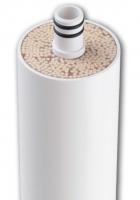
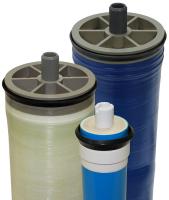
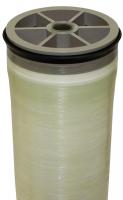
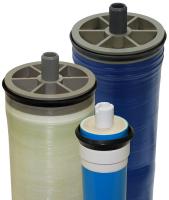
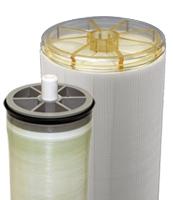
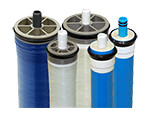
Ultrafiltration Membrane modules come in plate-and-frame, spiral-wound, and
tubular configurations. All configurations have been used successfully in
different process applications. Each configuration is specially suited for some
specific applications and there are many applications where more than one
configuration is appropriate. For high purity water, spiral-wound and
capillary configurations are generally used. The configuration selected
depends on the type and concentration of colloidal material or emulsion.
For more concentrated solutions, more open configurations like plate-and-frame
and tubular are used. In all configurations the optimum system design must
take into consideration the flow velocity,
pressure drop, power consumption, membrane fouling and module cost.

Membrane
Materials
A variety of materials have been used for commercial ultrafiltration membranes,
but polysulfone and cellulose acetate are the most common. Recently
thin-film composite ultrafiltration membranes
have been marketed. For high purity water applications the membrane module
materials must be compatible with chemicals such as hydrogen peroxide used in
sanitizing the membranes on a periodic basis.

Molecular-Weight
Cutoff
Pore sizes for ultrafiltration membranes range between 0.001 and 0.1
micron. However, it is more customary to categorize membranes by
molecular-weight cutoff. For instance, a membrane that removes dissolved
solids with molecular weights of 10,000 and higher has a molecular weight cutoff
of 10,000. Obviously, different membranes even with the same
molecular-weight cutoff, will have different pore size distribution. In
other words, different membranes may remove species of different molecular
weights to different degrees. Nevertheless, molecular-weight cutoff serves
as a useful guide when selecting a membrane for a particular application.

Factors
Affecting the Performance of Ultrafiltration
There are several factors that can affect the performance of an ultrafiltration
system. A brief discussion of these is given here.
Flow Across the
Membrane Surface. The permeate
rate increases with the flow
velocity of the
liquid across the membrane surface. Flow
velocity if
especially critical for liquids containing emulsions or suspensions.
Higher flow also means higher energy consumption and larger pumps.
Increasing the flow
velocity also
reduces the fouling of the membrane surface. Generally, an optimum flow
velocity is
arrived at by a compromise between the pump horsepower and increase in permeate
rate.
Operating Pressure.
Permeate
rate is directly proportional
to the applied pressure across the membrane surface. However, due to
increased fouling and compaction, the operating pressures rarely exceed 100 psig
and are generally around 50 psig. In some of the capillary-type
ultrafiltration membrane modules the operating pressures are even lower due to
the physical strength limitation imposed by the membrane module.
Operating Temperature.
Permeate
rates increase with increasing temperature. However, temperature generally
is not a controlled variable. It is important to know the effect of
temperature on membrane flux
in order to distinguish between a drop in permeate
due to a drop in temperature and the effect of other parameters.

Performance
of Ultrafiltration Systems
In high purity water systems, ultrafiltration is slowly replacing the
traditional 0.2-micron cartridge filters. In Japan, practically all of the
semiconductor industry follows this practice. An ultrafiltration membrane
with a molecular-weight cutoff of 10,000 has a nominal pore size of 0.003
micron. When an ultrafiltration membrane is used instead of a 0.2-micron
cartridge filter, particle removal efficiency is greatly improved. In
addition, ultrafiltration membranes are not susceptible to the problem of
bacteria growing through them, as is the case with 0.2-micron filters.
In a recent study (1),
the performance of an ultrafilter was compared with that of a 0.2-micron
cartridge filter. Some of these results are given in Table A.
The Ultrafilter used in the study had a molecular-weight cutoff of 100,000-
(pore size 0.006 micron). As the requirements for the quality of high
purity water become more stringent, we can expect to see an increasing use of
ultrafiltration as a final filter.
|
Table A |
|
Effectiveness of
Ultrafiltration Particle Counts on Waters |
| Test
Location |
0.2
Micron Filtered
DI Rinse Water |
Unfiltered
DI Rinse Water |
| 1 |
200-300 |
20-30* |
| 2 |
175-200 |
0-25 |
| 3 |
120 |
5 |
| 4 |
275 |
125* |
|
*Plumbing after UF not upgraded |

Operation
and Maintenance
Ultrafiltration system operation and maintenance is similar to that of reverse
osmosis systems. Daily records of feed
and permeate
flow, feed pressure and temperature, and
pressure drop across the system should be kept. Membranes should be
cleaned when the system permeate
rate drops by 10% or more. Feed flow is
critical to the operation of ultrafiltration systems. A drop in feed
flow may be due to a problem in the prefilter (if any), with the flow control
valve, or with the pump itself. When the system is shut down for more than
two days, a bacteriocide should be circulated through the membranes. At
restart, permeate
should be diverted to drain until all the bacteriocide is removed.

Conclusions
Ultrafiltration will find an increasing application in the production of high
purity water. The basic principles outlined here should help in the
understanding and use of this technology.

Reference
1Gaudet, P.W. "Point-of-use Ultrafiltration of Deionized Water
and Effects of Microelectronics Device Quality, American Society for Testing and
Materials", 1984.

Glossary
of Terms
| Feed
- Liquid to be treated by the
ultrafiltration system. |
| Permeate
- Liquid stream that passes
through the membrane. |
| Concentrate
- Remaining Portion of the
liquid stream after the permeate has been |
| Recovery
- Expressed as
percentage, this defines the permeate rate as a fraction of the feed
rate. Recovery provides an immediate measure of the maximum
concentrations in the system and it affects permeate quality, pump size,
power consumption and membrane fouling. |
| Flux
- Permeate flow per
unit area of membrane per unit time (gallons/ft²/day) |
| Rejection
- Percent removal of
a particular species by the membrane. Expressed as 1-CP
CF where CP is the concentration in t he permeate,
and CF is the concentration in the feed. |
| Flow
Velocity - Rate at
which the liquid goes along the membrane surface, expressed in length
per unit time (ft/sec). |

The Author
Dr. Gil Dhawan is the president of Applied Membranes, Inc. based in Vista,
CA. Dr. Dhawan has been involved in the design, development, and marketing
of ultrafiltration and reverse osmosis systems for the past 20 years.

|