
|

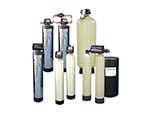
Water Softeners
Please
select a category below to view our water softener product line
|
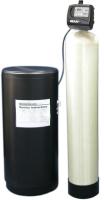
Single Water Softeners with
Timered Valves |
Single Water Softeners with a
timered valve are programmed to regenerate at a specific time of
day. They are usually scheduled to regenerate at 2am, when the
demands for soft water are expected to be very low. These can
be set to regenerate every day, every two to three days, or on
certain days of the week.
|
|
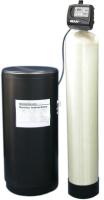
Single Water Softeners with
Metered Valves |
Metered Water Softeners are prompted to
regenerate based on the amount of water that has passed through the
unit. Like the timered softeners, these can
be programmed to regenerate at a certain time of day. Instead
of regenerating on a specific day as a timered softener does, the
metered softener does not schedule a regeneration until the
specified amount of water have passed through the softener.
These units can save water by preventing unnecessary regenerations
since it does not regenerate until the resin is near its capacity.
|
|
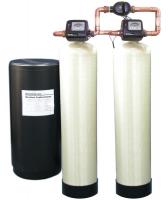
Twin Water Softeners with Metered
Valves |
Ideal for situations where
uninterrupted flow of soft water is a must, our twin softeners
consist of two resin tanks. One resin tank is always in
service, while the other tank is in standby. When the meter
determines that the resin is near its capacity, it will switch the
tank in standby to be in service, and the tank containing the
exhausted resin switches into regeneration, and then into standby.
|
Hard Water contains
dissolved minerals in the form of Calcium (Ca), Magnesium (Mg), and Iron (Fe).
Removal of these minerals is accomplished by softening the water through an ion
exchange process using a water softener. As the water flows through the mineral tank
of the water softener, the dissolved
minerals become attached to the resin, creating soft water. Over a period of
time the resin in the water softener will become exhausted, and the
water softener will regenerate using a
brine solution produced from the salt in the brine tank.
- Higher Quality Drinking Water
- Prevents Hard Water Scale
- Prevents Staining on Bathroom & Kitchen
Fixtures as well as Dishes, Dishwasher, Washing Machine and Clothes
- Significantly Reduces Soap and Cleaning
Product Consumption
- Provides Excellent Grooming & Cosmetic
Benefits
- Reduces Water Heating Costs
- Prolongs the Life of Water Heaters,
Icemakers, Dishwashers, Coffeemakers and Plumbing Fixtures.
A typical water softener has
four major items:
- Resin Tank
- Resin
- Automatic Valve or
Controller
- Brine or Salt Tank
Hard water flows over resin
in the resin tank.
Resin is in the form of tiny beads that have a special chemical property. At low
concentration of sodium in typical hard water, the resin beads adsorb (combine
with them) the hardness of water and replace it with an equivalent amount of
sodium in water. As hardness is removed the water becomes "soft". The resin has
a fixed capacity of the amount of hardness it can remove. Once that happens the
resin can no longer remove the water hardness and the resin is called
"saturated" or exhausted..
Fortunately,
the same resin when exposed to high sodium chloride (common salt) concentration
reverses the process and adsorbs the sodium and releases the hardness. This
property is utilized in regenerating the exhausted resin. This is done by
temporarily stopping the softening process and exposing the resin to high salt
solution from the brine tank. The entire process is controlled by the controller
valve which works either on time of regeneration (normally set at 2 AM) or by
a meter valve inside the controller preset to a calculated amount of water that
can be softened before regeneration. After regeneration the controller rinses
the resin to remove all salt not adsorbed by the resin. The entire cycle lasts
less than 1 hour.
The softening
process adds a very small amount of sodium
in the water which comes from the exchange process. It is not
directly added from the brine tank. For example, water with 10 grain hardness
will have a sodium addition of 80 ppm in the water after softening.

Sizing and Selection Information
for Water Softener:
Step 1: Calculate Total Hardness
as GPG
Usually chemical analyses report calcium (Ca) and magnesium (Mg) in terms of
parts per million (ppm) as calcium carbonate (CaCO3). However, in some cases,
the analysis is reported in terms of the elements themselves. If this is the
case, proceed as follows:
Calcium (as Ca)_________ × 2.50 = _________ppm Ca as CaCO3. (A)
Magnesium (as Mg) _________× 4.10 = _________ppm Mg as CaCO3. (B)
A _________ + B_________ = _____________Total Hardness PPM as CaCO3
Total Hardness PPM as CaCO3 _________ ÷ 17.1 = _________ GPG as CaCO3.
Step 2: Calculate Cubic Feet of Resin Required
_________ Gallons per Day × _________Total Hardness (GPG) = _________ Grains
per Day
_________ Grains per Day ÷ 30,000 = _________ Cubic Feet of Resin Required
Select the appropriate softener based on the volume of resin. When between
sizes, it is recommended to select the next size up.
Note: Above calculations are based on daily regeneration and maximum resin
capacity. Regeneration based on 15 lbs. of salt per cubic foot of resin.
|